
 In the Ohio State versus Kansas 2012 Final Four, rising star Deshaun Thomas, who attended my high school, played for the Buckeyes, so after taking Mom to the Y, we headed back to her memory care facility and settled in to enjoy the game. Mom started down the well-worn path of wanting to go home, being held hostage, keeping her in prison, calling me worse than horrible, and yadda, yadda, yadda. I wanted to watch a fellow Bishop Luers High School graduate play on the national stage, so I brushed aside Mom’s familiar tirade. Tuning out her incessant litany of blah, blah, blah, I told her to chill and kept my eyes fixed on the game.
Mistake.
The blow glanced off the side of my face and slammed into the sofa. A direct hit could have broken my nose, or at least set the stars in motion around my head. With Jedi instinct, I whirled around and pinned her arm to the couch.
Nose-to-nose I leaned in and foamed, “What are you doing? What is your problem?
In a death stare, she growled, “I never want to see you again.”
“Fine!” I shot back, “That would be fine by me! That would be just great!”
The spontaneous fury sparked a simultaneous combustion of thoughts that fired across my brainwaves:
Scott, what are you doing? This will have no positive effects.
Mom won’t remember anything I say. This will have no negative effects.
Maybe, an untethered venting will do me good, be good therapy for me.
Maybe not.
Maybe.
I made the conscious choice to blast away and ripped up the room in a verbal diatribe. “Maybe, I’ll never talk to you again! What do you think of that? Huh? I’ll leave and not come back. How ‘bout them apples?” A sophisticated repartee of twinkle-twinkle-little-star-what-you-say-is-what-you-are from a mature, fifty-year-old. As I let it fly, I also thought, Whoa, am I going too far?
Someone knocked on the door.
“Scott, is everything alright?”
I recognized Brenda’s voice, the night-duty nurse, a wonderful friend and support for Mom. In a lightning flash, I swirled back to my seat and prepared to point a finger at my mother and confess, “She started it,” with the follow up, “She hit me first.” But the door didn’t open, so I said with the best calm voice I could muster that all was well.
Mom and I sat in silence for a long time.
Yep, too far. Great job, Scott. Idiot.
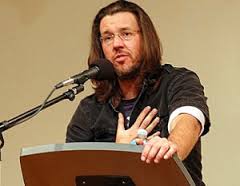
Last summer, my daughter sent me via Facebook a video excerpt from David Foster Wallace’s commencement speech at Kenyon College, This is Water. Wallace departs from 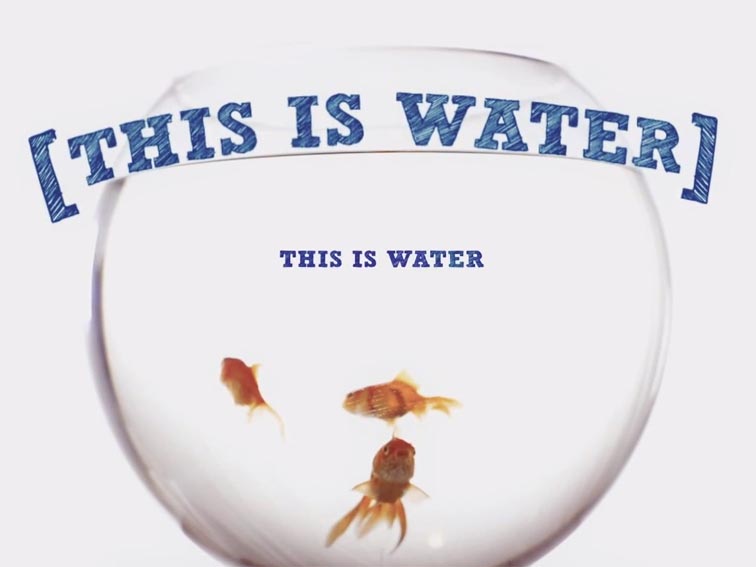 the customary aim-high, be-all-you-can-be blather at such occasions and challenges the graduates to shake themselves from autopilot thinking: the unconscious assumption that we as individuals are the center of the universe and all life revolves around our personal needs.
This natural inclination will blind us from seeing the true value in others. Our automatic default setting registers with certainty that our all-too-common, petty frustrations (getting stuck in traffic, waiting in long checkout lanes) are caused by all these annoying people. Instead of seeing their worth, we see them as obstacles in our way.
Wallace posits that we have other options. He states that the real freedom of real education is we get to consciously decide how we are going to view others. We can choose to think the best in others. This takes disciplined effort, and we will not always succeed. At times, it may not necessarily be reality, but to do otherwise leads down the miserable road of non-thinking autopilot: “The alternative is unconsciousness, the default setting, the rat race, the constant gnawing sense of having had, and lost, some infinite thing.” We forfeit the wonder, the hidden grandeur in people: love, fellowship, and unity.
At nineteen, I worked at a church camp as a summer counselor. We had two weeks set aside where hundreds of inner city students received sponsorships and attended camp. The impressive program gave children who didn’t have such opportunities a week to swim, fish, boat, hike, play sports, and hear the Bible taught creatively with fun skits and activities. (For one sketch, I dressed up as the devil and ran down the aisle. Mistake. I got kicked, spit, scratched, smacked, mauled and barely made it out the exit alive.)
The first week I had a crew of 4th and 5th grade rowdies with a few standout wild ones. We had a good week, but keeping them corralled 24/7 for six days presented no little challenge. With one student, I had a Clint Eastwood, “Go ahead make my day” showdown at the lodge. A tough kid, who exhausted my patience, and I fantasized about squeezing his face (and foul mouth) in a headlock until the end of summer. And it got worse. He bewildered me on that last, fateful Saturday by saying he received permission from the camp director to come back for the second week, and also, he requested me as his camp counselor again. He smiled as if he had planned some new and improved deviant behavior to experiment with on me. I was not a happy camper, but said I would be glad to have him again. Lie.
I don’t remember anything about the second week, except the end. On the last day, after two weeks of hell with this flippant, rough and raucous kid, he pulled me aside to talk. He started out by whispering in my ear so no one else could hear, and he ended up in full-blown tears.
His parents were getting divorced, and he didn’t know what to do.
Perspective.
His story, and a few others like him, began a paradigm shift in me that continues to this day. Young people (and old people) are not often as they appear.
Many have well-hidden hardships and sorrows, “even in laughter the heart may ache” (Proverbs 14:13), but they press on. If we operate on our natural default setting that we are the center of the world, if we don’t pay attention, then we never see the nobility of their lives. We waste away our days on ourselves, unaware of others. We will be the ones who lose.
 Cora and I read dozens of the Chicken Soup books as she grew up. The “tough stuff” series made for great discussions. Some stories choked me up so bad I couldn’t finish reading. The Kid would grab the book with the usual comment, “Daaad, really?” followed by an occasional, “You are so pathetic,” and she would finish the story. What can I say, I like happy endings…when good stuff happens to people. Sheenagh Pugh’s poem, “Sometimes,”strikes me:
A people sometimes will step back from war;
elect an honest man, decide they care
enough, that they can’t leave some stranger poor.
Some men become what they were born for.
(excerpt)
Maybe the Apostle Paul, writing from prison,  understood seeing the best in others and in life when he wrote, “Finally, brothers and sisters, whatever is true, whatever is noble, whatever is right, whatever is pure, whatever is lovely, whatever is admirable—if anything is excellent or praiseworthy—think about such things” (Philippians 4:8 TNIV).
St. Paul and Wallace’s wisdom takes conscious effort, because we have the natural tendency to fall into what psychology calls the Fundamental Attribution Error. Simply stated: if I run through a red light, I have good reason to be in a hurry; if you run through a red light, you’re an idiot. We judge ourselves by good intentions and justify our bad decisions by external factors, so it’s not really our fault, but if others make the same bad decisions, we automatically assume they have character flaws.
Choosing to see and think the best in people may at times miss reality, but it is not naïve. Consider the gains worth the risk. How many students could be pulled back from the darkside into the light and morph into something beautiful if just one person believed in them? Could that make all the difference? If someone proves us wrong, even then, to quote Shakespeare’s Hamlet, “Lord, we know what we are, but know not what we may be.” How true with youth. Choose to see beyond what they are (and the moronic things they say and do), and view them from the perspective of what they may become. This conscientious thinking that Wallace articulates will add value, and maybe some compassion, to a messed up world. Given my own propensity to do stupid stuff, I will take the risk.
G.K. Chesterston, the great Catholic thinker, author and prolific essayist, responded to a London Times newspaper inquiry, “What’s wrong with the world today?” with two words composed of three letters.
“I am.”
Sitting with Mom at the Memory Care Center, after my head-spinning blowup, in silence I got up and walked out the door, shutting it behind me. I stood in the hallway, waited for a minute, and then swung open her door and walked in.
“Hi, Mom! Want to watch the ballgame together?”
Sitting on the couch, she looked up at me with surprise and held out both arms for a hug and said, “Scott! Great to see you!”
Mom’s dementia allowed me a retake, a second chance, a gift we don’t often receive, but…
“It is never too late to be what you might have been.” –George Eliot.
https://www.youtube.com/watch?v=0lu2e-q8ntM
“This is Water” –David Foster Wallace


 Moments of Mom